
Under what authority? Two years of contested operations by Timor-Leste’s Urban Affairs Office

License plates removed with no clear legal basis. Livestock killed in operations the country’s chief veterinary official says she knew nothing about. Allegations of beatings and deleted videos. Since 2024, the operations of a government office in charge of urban affairs have raised a basic question: Who decides on these interventions, with what powers and under what procedures?
By Rilijanto Viana
Originally published by Diligente on Oct. 11, 2026.
DILI, Timor-Leste — On Sept. 15, 2026, officials from the National Directorate of Land Transport in Timor-Leste were removing license plates from motorcycles parked on the sidewalk outside the Fundação Oriente in Dili, the capital. The Fundação Oriente, a private Portuguese cultural foundation, was hosting a literary festival that day.
The transport officials were accompanied by staff from the Secretariat of State for Toponymy and Urban Organization, known by its Portuguese acronym, SEATOU. The operation extended into the foundation’s grounds, with reports of people being beaten, phones being taken and videos being deleted.
The foundation had not authorized anyone to enter. Dili’s municipal government says it neither requested the operation nor took part in it. Tomás Cabral, the minister of state administration, who oversees SEATOU, acknowledged the mistake: “SEATOU was wrong to go in.”
What happened at the Fundação Oriente
According to Basílio Sanches Sávio, the festival’s organizer and head of the literary group Movimento Letras, the intrusion frightened the children attending and halted a creative-writing session for about two hours. One participant, who asked not to be named, says he was chased into the grounds and punched and kicked by about seven members of the SEATOU team. He was left with an injury to his back.
The phones of people who had been filming were reportedly taken to SEATOU’s offices and returned the next day. “When we went to get the phones back, all the videos had already been deleted,” Sávio said.
The participant who says he was beaten blames SEATOU staff for deleting the videos and points to the foundation’s security cameras as another source of footage.
The foundation’s local representative, Joana Camargo Saraiva, confirms that the security cameras recorded part of what happened. The footage, she says, can be handed over to the authorities upon formal request.
SEATOU tells a different story. According to the office, a young man picked up a stone to throw at the team and then ran into the foundation. SEATOU says he was pursued so that he could be taken to the secretary of state, Germano Santa Brites Dias, for a conversation.
Dili’s municipal government distances itself from the operation. “The Municipal Authority made no request to SEATOU and was not involved in the operation at the Fundação Oriente,” said its president, Francisco dos Santos.
Because the foundation is Portuguese, the incident took on a diplomatic dimension. Cabral said he had received a letter of protest from the Portuguese Embassy. He said he replied to the ambassador, apologized and instructed SEATOU to follow its operations plan.
“Enforcement can happen in public spaces, but on private premises and at embassy sites we have to be more careful,” he said.
One person who attended the foundation’s events, and who asked not to be named, said a complaint was filed with Timor-Leste’s National Police, known as the PNTL.
“So far we haven’t received any information about the case, and no one has called us to give a statement,” the person said. Diligente was unable to confirm with the PNTL that a complaint had been filed.
Sávio said the organizers had not sought a permit for the event. “We didn’t ask for authorization because the Fundação Oriente has hosted many events like this, and until then no one had ever interfered,” he said.
Legal expert Olívio Barros questions the legal basis for the intervention. “We have to ask: Did SEATOU go in to check or not? What happened at the Fundação Oriente before it took such a forceful step as removing or seizing property?”
Powers that depend on delegation
In Timor-Leste, a secretary of state is a junior member of the government who works under a minister. Two decrees set out the government’s structure, and on this point they agree.
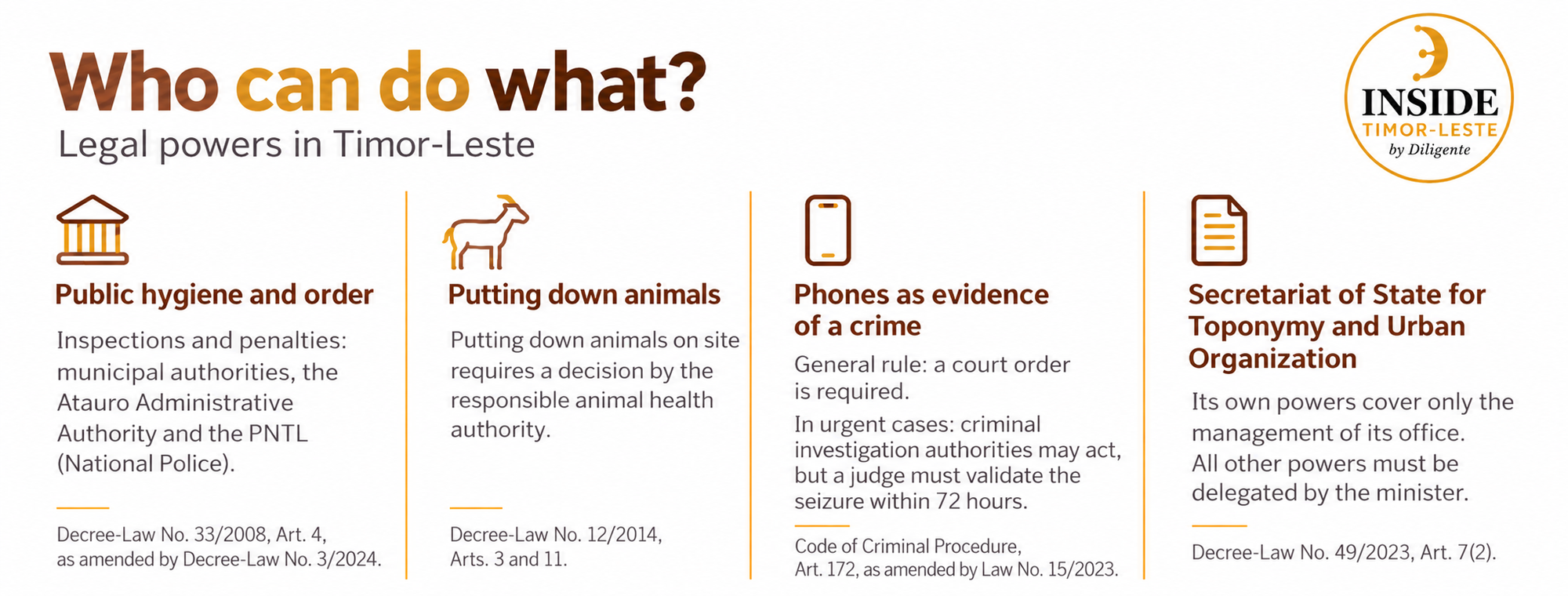
Under Article 7(2) of Decree-Law No. 49/2023 and Article 9(1) of the decree that set up the current government, the ninth since independence, a secretary of state’s own powers extend only to the management of their office. Any other powers must be delegated by the minister.
The delegation must be made in writing, must specify the powers being delegated and the law that allows it, and must be published in the Jornal da República, Timor-Leste’s official gazette.
In response to questions from Diligente, Cabral described SEATOU as having powers of its own. “SEATOU has two responsibilities: urban organization and toponymy,” he said. Toponymy covers the naming of streets and places.
SEATOU did not provide Diligente with the order delegating those powers or with a reference to where it was published. A search conducted with the help of staff at the National Printing Office, which publishes the gazette, also failed to locate it.
“After the interview with His Excellency, we can share the document,” a SEATOU adviser said.
In Barros’ view, SEATOU can take part in organizing public spaces, but it cannot carry out evictions, demolitions or road widening on its own. “SEATOU’s authority is in fact limited to matters of this kind, but it has to work together with the municipal authorities and not act alone,” he said.
A minister can delegate only powers that the law grants and allows to be delegated, Barros said. Nor can a minister use delegation to hand over powers that the law reserves for municipalities or the police.
“Simply naming an office ‘Urban Organization’ is not a sufficient legal basis for taking coercive action or imposing obligations on citizens,” he said.
The regulations on public hygiene and order, set out in Decree-Law No. 33/2008 and republished in 2024, give municipal authorities, the administration of Atauro island and the PNTL the power to inspect and impose penalties. SEATOU is not on the list.
Dos Santos, the Dili municipal president, described SEATOU as “a supervisory body,” without citing any law that would give it that role. The hygiene regulations do not assign it that function.
Dos Santos acknowledges he does not know about all of SEATOU’s operations. “They carry out operations without involving me. I mean, I’m not aware of it.”
Asked about SEATOU’s powers, he deferred to the office itself: “It’s better to ask SEATOU directly to explain the operations it carried out.”
Joint operations do not settle the question. Putting civilian officials on a team with police officers does not give them police powers, Barros said. So it matters who leads, who decides and who carries out each measure. “SEATOU oversteps a bit,” he said.
Procedure matters, too. As a general rule, administrative decisions must state their legal grounds, and the people affected must be notified before the decisions are carried out.
Under the hygiene regulations, a violation triggers a formal proceeding in which officials file a written violation report and the person has 20 days to contest it or pay the minimum fine.
Separately, Article 6 requires violators to remove certain objects and materials immediately. If they don’t, the government may remove them, but that does not amount to a general license to destroy property.
Each intervention must follow the applicable procedures, Barros said, and urgency is no excuse for measures that are unnecessary or disproportionate.
License plates removed: on what legal grounds?
By August 2026, license plates had been removed from more than 200 vehicles in joint operations by the land transport directorate, SEATOU and the traffic police. The operations were carried out at SEATOU’s initiative, according to João Eugénio da Silva, head of the directorate’s roads department.
As he described it, transport officials removed the plates, SEATOU oversaw the use of public space and the police provided security. He acknowledged, however, that police officers and SEATOU staff sometimes also helped remove plates.
Samuel Sanches, who says he witnessed one of these operations in the Vila Verde neighborhood, offered a different account: SEATOU gave the orders, the transport officials kept records and the police removed the plates.
João Eugénio da Silva also said there is no specific law authorizing plate removal. He cited Article 4 of the traffic code to justify a $45 fine. Timor-Leste uses the U.S. dollar, and the national minimum wage is $115 a month, so the fine comes to nearly 40% of a month’s minimum pay.
Article 4 punishes disobeying lawful orders from traffic authorities with fines of $9 to $45, but it says nothing about removing license plates. Fundasaun Mahein, a Dili-based watchdog group, and legal expert Sérgio Quintas have raised the same concern. The transport directorate did not produce the order authorizing the measure.
“To show our authority to citizens, there’s no need to take off their license plates. If a person breaks the rules, we should issue them a notice to pay the fine,” Barros said.
Phones seized: on what grounds, and what happened to the videos?
Under Article 172 of Timor-Leste’s Code of Criminal Procedure, seizing objects connected to a crime or useful as evidence generally requires a judge’s order. In urgent cases, or where delay poses a risk, criminal investigation authorities may act without prior authorization, but they must notify a judge immediately.
A seizure must be documented in a written record. When carried out by criminal investigation authorities, it must be validated by a judge within 72 hours, or it is void.
At the Fundação Oriente, it is not known whether any record was made, what legal grounds were invoked or who deleted the videos. “SEATOU is not the police,” Barros said.
It has happened before. In September 2024, during an operation targeting street vendors in the Kampung Baru neighborhood, journalist Suzana Cardoso of the outlet Media One Timor reported that her phone was taken and a video deleted.
Santa Brites admitted that he had ordered a halt to the coverage and the deletion of a video, saying the situation was out of control.
Virgílio Guterres, the Office of the Ombudsman for Human Rights and Justice, Timor-Leste’s national human rights institution, called the incident a serious attack on press freedom. President José Ramos-Horta, a Nobel Peace Prize laureate, condemned SEATOU’s methods as “aggressive, unprofessional and unethical.”
Animals killed: who authorized it?
In July 2025, Maria da Silva, a resident of the Metiaut neighborhood in Dili, told Diligente that a SEATOU team had killed one of her goats and that two others had disappeared. She said the animals helped support her family and that the community had not been directly warned.
Alípio de Almeida, of the Association of Veterinary Doctors, warned of the risk of distributing meat without checking the animals’ health.
Article 8 of the hygiene regulations allows stray animals to be impounded when the owner is unknown and gives owners 15 days to claim them. It does not provide for killing them on the spot.
A separate law, Decree-Law No. 12/2014, does allow animals to be put down on site, but only by decision of the responsible animal health authority, which the law identifies as the agriculture, livestock and veterinary services. It also provides for administrative and police authorities to assist, at those services’ request.
The country’s director-general of veterinary services, Joanita Benedita da Costa, told Diligente she knew nothing of the killings. “We don’t know. Everyone does whatever they want, and it’s hard to talk to them,” she said.
“We’ve already spoken with the secretary of state for livestock about this. But we still don’t know whether SEATOU will coordinate its activities with us from now on,” she added.
Demolitions and evictions: who decided, and what procedures were followed?
In 2024 and 2025, SEATOU took part in demolitions and evictions in several parts of Dili, raising questions about procedures and compensation.
In the Becora neighborhood, 19 families were evicted in April 2024 to expand the bus terminal. Santa Brites said the families had been notified and that an order had been issued to carry out the work.
In the Fomento II neighborhood, homes along the Comoro River were demolished in January 2025, with officials citing the risk of flooding, and compensation of $3,000 to $5,000 was announced.
In Aspol, in the Caicoli neighborhood, used-clothing vendor Basílio da Silva said that in September 2025 vendors were given one to three days to leave. At the time he was interviewed, he said he had received neither compensation nor a reply to his request for another place to sell.
Widening the road between the Kuluhun and Fatu Ahi neighborhoods in 2025 affected 177 households, according to Rede ba Rai, a land rights network. Compensation offers ranged from $5,000 to $15,000, and there were complaints about delays.
In Barros’ view, a road-widening plan alone does not justify an eviction. “In practice, we often don’t see these procedures being followed. SEATOU frequently interferes or ends up taking over powers that belong to other ministries,” he said, noting that his assessment is based on news reports.
Law No. 1/2025, enacted in March 2025, assigns decisions on demolitions and evictions to the government services responsible for building and zoning control and sets out procedures for notification and enforcement.
The law provides for eviction within 30 days of notification, with immediate eviction permitted in cases of imminent danger under the conditions it specifies.
Diligente was unable to determine whether the National Directorate of Buildings, part of the Ministry of Public Works, took part in the operations described.
Other operations: the use of force and the seizure of property
On Oct. 23, 2024, street vendor Zeca Barreto was injured during an operation in Kampung Baru and was treated at Guido Valadares National Hospital, the country’s main hospital.
According to the account Diligente published at the time, he was beaten and struck in the arm by a bullet allegedly fired by a PNTL officer accompanying SEATOU.
His family announced it would file complaints with the public prosecutor’s office and the Scientific Police for Criminal Investigation, the country’s criminal investigation agency. President Ramos-Horta asked the prosecutor general, who heads the public prosecutor’s office, to investigate. The president also said the hygiene regulations did not authorize attacks on vendors or the destruction of their goods.
In the Bidau-Sengol neighborhood, resident Cipriano Belo and vendor Maurício Freitas told Diligente that Santa Brites threatened to seize vendors’ goods and throw them into the stream if they did not leave.
Cleaning up and organizing the city does not, on its own, justify assault or the destruction of property, Barros said.
Coordination among government bodies also came into question on Dec. 17, 2025, when the dismantling of tents at a Christmas fair near the Presidential Palace led to a dispute among SEATOU, the Office of the President and Dili’s municipal government.
The Timor-Leste NGO Forum, an umbrella group of nongovernmental organizations, criticized the lack of coordination.
Who is accountable
Barros says the entry into the foundation’s grounds, the chase, the alleged beatings and the seizure of phones each raise separate legal questions. “Legal authority gives you the power to take measures, not to beat people arbitrarily,” he said.
An assault may amount to the crime of bodily harm, punishable under Article 145 of the Penal Code by up to three years in prison or a fine, but it is not automatically torture. “Bodily harm does not necessarily require visible injuries,” Barros said.
The rules on the use of force, in Decree-Law No. 43/2011, require that nonviolent means come first and that any use of force be preceded by a warning and be necessary and proportionate.
A superior’s order does not, on its own, shield anyone from criminal liability, Barros said. To hold those who carried out or directed an operation accountable, prosecutors must prove what each person did or ordered.
Besides criminal penalties, there may be disciplinary sanctions and compensation for victims. In cases covered by the law on the use of force, the state may also be liable to pay that compensation.
“The responsibility of the officers who carried out the operation and of their superiors must be determined individually, according to their part in the events,” he said.
On Oct. 2, Diligente requested an interview with Santa Brites. On Oct. 5, his office replied that SEATOU was “available to grant the interview.” Diligente was later told that the secretary of state was abroad, with no alternative date offered.
Orlando Gomes, the PNTL commander in Dili, declined an interview request. Through an officer, he said he had already discussed the matter with other journalists. Diligente also sought interviews with the head of the land transport directorate and with the minister of public works, without success.
Two years after the first reported operations, residents have seen the effects of SEATOU’s operations. What they still don’t know is whether the limits on its authority will be respected, and whether any abuses will have consequences.