One year in ASEAN, Timor-Leste's trade gains remain hard to measure
Timor-Leste now has a seat at regional negotiating tables and an approved economic roadmap. Businesses say production problems still keep them out of regional markets.
Timor-Leste now has a seat at regional negotiating tables and an approved economic roadmap. Businesses say production problems still keep them out of regional markets.
By Yane Elfrida
Originally published by Diligente on Nov. 11, 2026.
DILI, Timor-Leste — During the coffee harvest, an extra 5 or 10 cents per kilogram can decide who a farmer sells to.
Indonesian buyers sometimes pay that difference when they travel to Estado and Letefoho to buy directly from farmers, said Afonso Alves, vice president of the Timor-Leste Coffee Association (ACTL). Farmers get a better price. Exporters, however, may have a harder time filling contracts with clients in Australia and North America.
"They take the raw coffee, they don't process it here, they don't employ our people, and the coffee leaves the country without Timor-Leste's name on it," Alves said.
ACTL and the Chamber of Commerce and Industry of Timor-Leste (CCI-TL) want rules that limit exports of unprocessed raw materials.
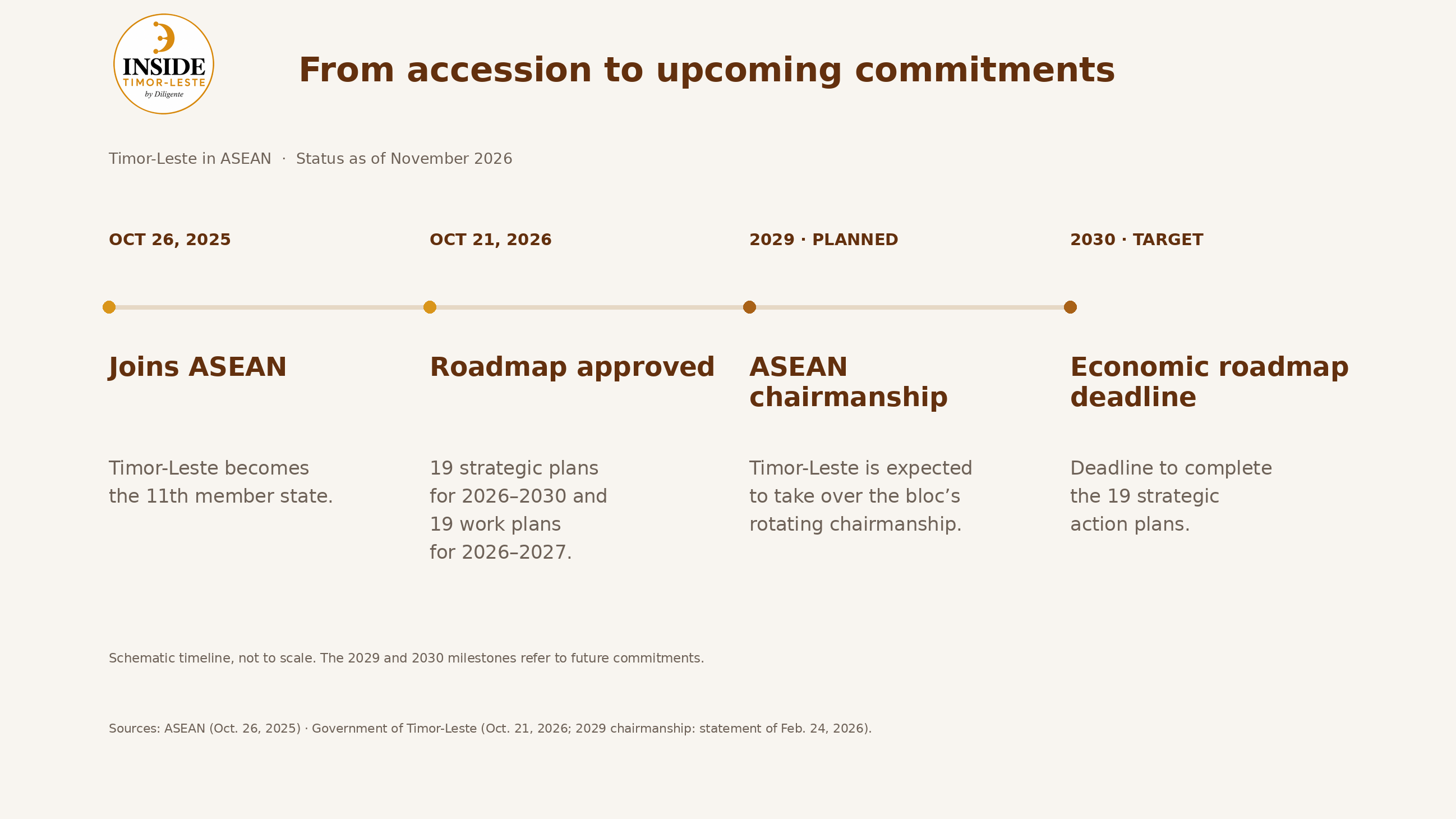
The coffee dispute illustrates the challenge Timor-Leste has faced since it joined the Association of Southeast Asian Nations (ASEAN) on Oct. 26, 2025. Coffee is the country's main non-oil export. Selling more of it depends on producing more and processing it locally.
Business contacts, but no measured trade results
Timor-Leste produces 6,000 to 9,000 metric tons of coffee a year, Alves said. He estimates that installed capacity would allow production of up to 15,000 tons. Quality is an advantage, but the country has little room to compete with Indonesia and Vietnam on volume.
Coffee exports reached $8.9 million in the first half of 2026, according to a semiannual report from the Central Bank of Timor-Leste.
Data from the National Statistics Institute of Timor-Leste (INETL) show that Indonesia and Singapore together bought about $7.19 million worth of Timorese coffee in 2025.
Jorge Serrano, president of CCI-TL, said the first year was a period of contacts and adjustment. The chamber joined the ASEAN Business Advisory Council and identified early-stage contacts in tourism, motorcycle assembly and community agriculture. It has no record of members that began exporting new products or increased sales because of ASEAN membership.
Under the ASEAN Trade in Goods Agreement (ATIGA), Timor-Leste has two years from full accession to cut tariffs covered by its ASEAN commitments to zero, said Milena Rangel, vice minister for ASEAN affairs. It can request an extension if it provides justification. The effect on prices will depend on the products, current tariffs and how much of the tariff reduction importers pass on to consumers.
ACTL's proposal to limit raw coffee exports runs into trade rules. Article XI of the General Agreement on Tariffs and Trade (GATT) in principle prohibits export bans and quotas. Article 41 of ATIGA applies that rule among ASEAN members. A ban would require an exception. An export tax falls outside Article XI, but whether it is viable depends on Timor-Leste's other trade commitments.
Tariffs are only one part of selling in the region. The National Directorate of Quarantine and Biosecurity can issue phytosanitary certificates. Laboratory tests that destination markets may require are a separate issue. Because some of these tests lack international accreditation, it may be hard to prove that products meet requirements.
During reporting for this story, customs clearance at the port of Tibar and at land borders was described as slow and bureaucratic. Sources also cited unstable electricity and water networks inadequate for agricultural processing.
What has changed in government
The most immediate change was diplomatic. Timor-Leste went from observer to full member and gained a seat at the negotiating table. It also joined the Initiative for ASEAN Integration, which was created to narrow gaps between members.
Rangel told The Diplomat in October 2026 that Timor-Leste had prepared six initial proposals under the initiative. Three have been finalized and submitted to the ASEAN Secretariat.
On Oct. 21, 2026, the Council of Ministers approved the National Roadmap for Implementing ASEAN Economic Commitments 2026-2030, with 19 sectoral action plans. The work involves adapting laws and procedures. For the civil service, it has meant more meetings, more technical documents and more national positions to prepare.
"We have a culture in which we usually do everything 'santai hela deit' and 'neneik hela,'" Rangel said, using expressions that mean calmly and slowly.
The vice minister acknowledged delays in keeping up with ASEAN's pace. She said it was too early to expect visible changes for households after one year.
To catch up, the government is training staff and assigning officials to regional work. By June 2026, about 36 focal points across ministries and 17 liaison officers were in place, most at the Ministry of Foreign Affairs and Cooperation (MNEC), according to the Civil Service Commission (CFP). Much of the training is funded by Australia through an ASEAN and WTO accession support package worth 11.8 million Australian dollars (about $7.8 million). Its English-language program has trained about 272 people since 2025 and has 100 more on a waiting list.
Timor-Leste will chair ASEAN in 2029. The National Organizing Council began work in February 2026 and is assessing needs in infrastructure, human resources, security, communications and financing.
Spending on identified budget lines
Asked how much the state spent in its first year in ASEAN, Rangel said she did not know the amount. She declined to answer because she did not consider the figure important. She added that some of the spending is part of routine state operations.
As of Nov. 10, 2026, $1.77 million had been spent under two budget lines for regional and ASEAN affairs, according to the Transparency Portal. That is about 57% of the lines' combined allocation of $3.10 million. About $1.61 million went to ASEAN accession and $152,000 to roadmap implementation.
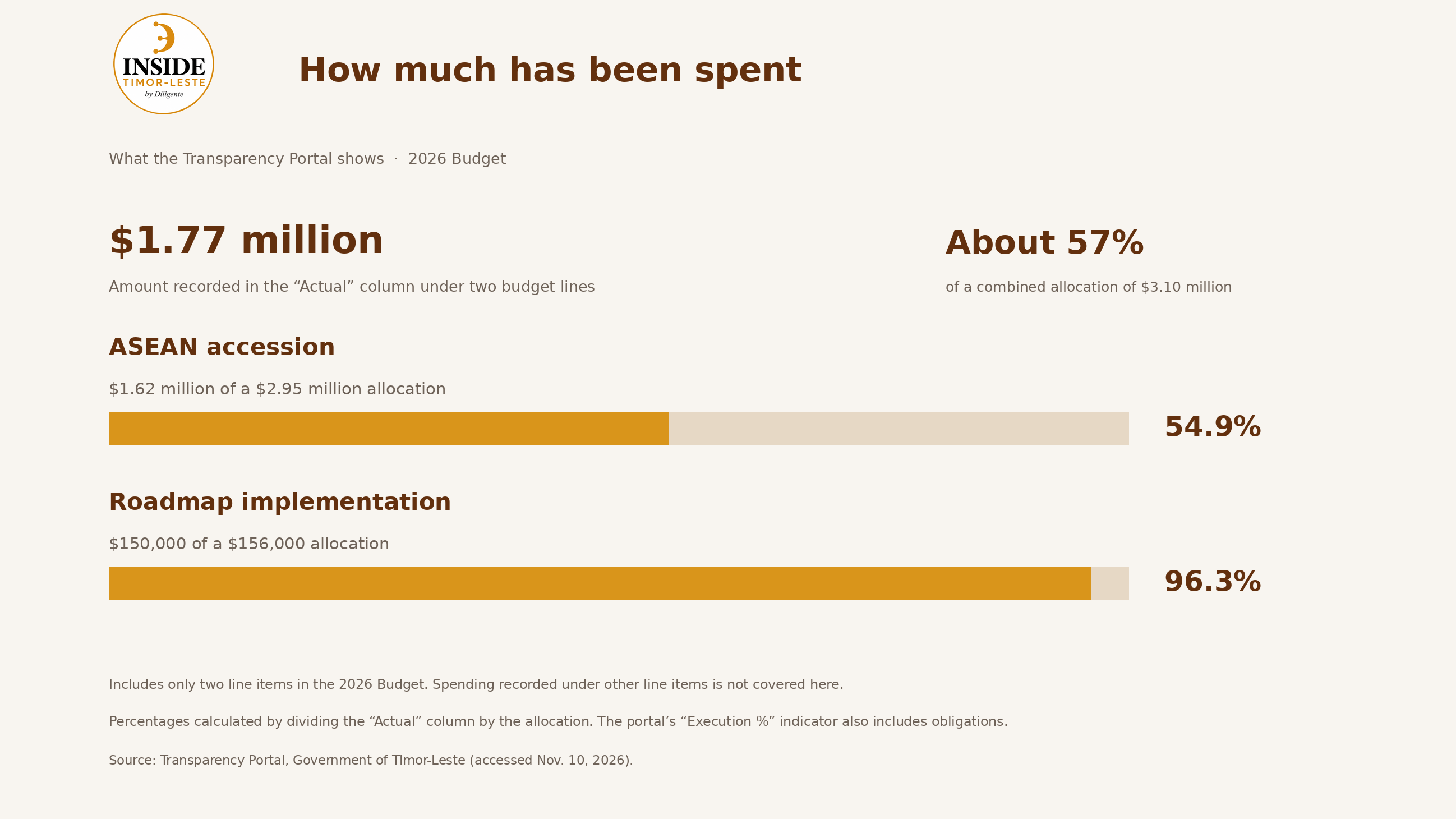
La'o Hamutuk, Timor-Leste Institute for Development Monitoring and Analysis, said that because the portal figures cover only two budget lines, they do not show the full first-year cost. Calculating that cost would require knowing what other services spent and how much went to travel, contributions to organizations or training. The organization is calling for regular public accounts broken down by ministry, activity and amount.
"A government official has a duty to report expenses and spending so we know who benefits," the organization said. "Unfortunately, this doesn't happen. It often seems they treat public money like a one-person company, spending it only as they see fit."
Opportunities for young people, with conditions
LafaekDev won the 2026 national final of the ASEAN Data Science Explorers. The team is made up of Romário Marçal, a Telkom University student, and Ronaldo Ima Dias do Rego. It qualified for the regional final in Manila, Philippines.
Marçal said information about opportunities is easier to find now. "The main problem isn't just a lack of information. It's knowing where to access it, how to apply and what the requirements are," he said
Maria Abrantes, a youth activist who represented Timor-Leste at the ASEAN Youth Creative Meeting, said organizers do not always cover all costs. When they don't, participants may have to pay for travel up front while they wait for a decision on public support.
"If young people don't have money and don't have support from the government, it's difficult," she said.
Abrantes also said young people training in engineering, mechanics, agriculture and hospitality lack equipment. "After vocational training, we don't know where to place our young people so they can practice," she said.
Rangel said working in another ASEAN country is governed by different rules than taking part in regional competitions and meetings. Membership does not automatically give Timorese the right to work elsewhere in the bloc. Mutual recognition agreements exist for engineering, architecture, medicine and nursing, subject to the rules of each profession and each country.
From Tilomar to Díli, residents and merchants raise concerns
Residents of Tilomar, in Covalima municipality, said news about ASEAN reaches them mainly through radio and television.
"The biggest change has been in prices, especially for essential goods, and life keeps getting more expensive," said Ferdiano Petros, a Tilomar resident.
Because tariff cuts under ATIGA are still being phased in, it is unclear how much of that increase is linked to ASEAN membership.
"Our concern is how we will compete in ASEAN if our economy is not stable, local production is not enough and security is failing," Petros said, "with criminals from other countries coming here to hide and run online gambling schemes."
The U.N. Office on Drugs and Crime (UNODC) documented a search on Aug. 25, 2025, at a hotel in Oé-Cusse. The search was part of an investigation into suspected online fraud. Warnings about this kind of fraud predate Timor-Leste's ASEAN accession.
Eduarda Fernandes, a resident of Metiaut, in Díli, said goods imported from the region are competitively priced.
"In the end, ASEAN's benefits are still only for a few elites," she said.
Maria do Céu, who owns a clothing and beauty business in Díli, said foreign buyers purchase secondhand clothing in Timor-Leste to resell. Small foreign-owned businesses are also opening in local neighborhoods.
"The government should look into this. This has to be left to Timorese to do," she said.
What one year shows
A year in, some changes are identifiable. Timor-Leste takes part in regional decisions as a full member, has an approved economic roadmap and has submitted cooperation proposals to the ASEAN Secretariat. Some young people have taken part in regional initiatives. The effects on exports, investment and household income have yet to be demonstrated.
La'o Hamutuk said low productive capacity and dependence on public spending limit the benefits of regional integration. The group fears Timorese will consume more imported goods without domestic production growing stronger.
"If the country fails to take advantage of these opportunities, we could become just a spectator," said Marta da Silva, a La'o Hamutuk representative.
For Serrano, the key question is what Timorese companies will be able to sell in the region.
"We are now in the ASEAN market, but we have to go there with products," he said.