
Tourism site built at a cost of about $800,000 remains closed in Manatuto, Timor-Leste
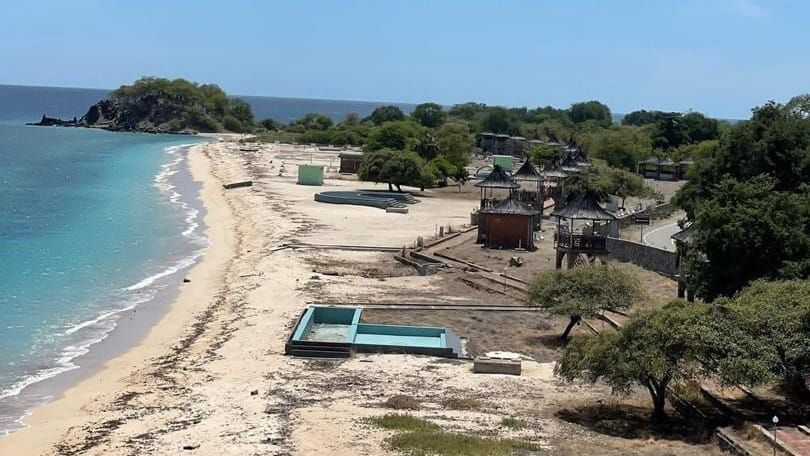
Pools are empty and the gate is locked at One Dollar Beach, a government-built community tourism project meant to bring visitors and income to a coastal village. Responsibility for managing the site remains unresolved, and no date has been announced for repairs.
By Rilijanto Viana
Originally published by Diligente on Sept. 3, 2026.
DILI, Timor-Leste — The three pools at One Dollar Beach are empty, and the entrance gate is locked.
About $800,000 in public money went into turning this stretch of white sand on Timor-Leste’s north coast into a community tourism site, according to a former government official. At the time of Diligente’s visit, the site had neither running water nor electricity. Its condition raises questions about the project’s management and future.
One Dollar Beach, about 38 kilometers (24 miles) from Dili, or roughly a 45-minute drive, remains one of the most promising spots for tourism in Manatuto, a municipality that lies east of the capital and stretches from the island’s north coast to its south coast. The facilities built for visitors, however, are deteriorating.
During a visit to the site, in Uma Kaduak village in the Laclo administrative post, Diligente found restrooms with no water supply, broken faucets, small buildings in disrepair and a nonfunctioning electrical system.
The pools sit along the shoreline, where waves hit some of the structures directly. Coastal erosion is damaging their foundations and could eventually make the facilities unsafe.
Some of the 16 small buildings have damaged roofs. Stairs and metal structures are rusting, some parts are broken, and several lights no longer work.
From a community beach to a state project
Residents were using the beach long before the state stepped in. Ferminio Ribeiro da Cruz, chief of Uma Kaduak village, said locals began running small businesses there in 2000, selling fish, coconuts and other goods, including katupa, rice wrapped in palm leaves.
That was also when the beach got its current name, he said: visitors were charged one dollar to park. Before that, it was known as Redan Leet, or White Sand Beach.
The community put up small structures with local materials and found ways to earn some income. “A group called Ilimano Anan also invested in the site, but internal conflicts ended up halting the initiative,” Ferminio said.
The government later turned its attention to the area, considering One Dollar Beach for tourism development, including through public-private partnerships.
Official documents from the National Development Agency (ADN, its Portuguese acronym) record a 2018 project to build the One Dollar Beach community tourism site under the Secretariat of State for Vocational Training and Employment (SEFOPE, its Portuguese acronym). The project included the construction of 16 small buildings for visitors, five spaces intended for cafés and the sale of local products, three pools, a protective wall, a futsal court and a beach volleyball area.
Paulo Alves, a former director-general of SEFOPE, said the investment came in two phases. The first cost about $500,000. The second, for the wall around the site, cost about $300,000, he said, bringing the total to about $800,000.
Community tourism is part of national tourism policy. Approved in March 2017, the National Tourism Policy set 2030 targets of 200,000 international visitors a year and $150 million in annual international tourism revenue, at 2016 prices. It also aimed to increase tourism employment from about 4,300 jobs to 15,000 and generate income and opportunities for local communities. In 2023, the government approved a National Strategic Plan for Tourism Development covering 2023–2030 and created the Timor-Leste Tourism Authority. The authority’s statutes require it to support community tourism by encouraging associations, cooperatives and entrepreneurship.
A report released by the Pacific Tourism Organisation in partnership with the Ministry of Tourism and Environment estimated 48,927 international visitor arrivals in 2025. The estimate includes visitors traveling for vacation, business and other purposes and is not directly comparable with the total number of foreign arrivals recorded at Dili’s airport.
Water pump remains out of service despite a contract worth about $30,000
In 2022, responsibility for the site passed from SEFOPE to the then Ministry of Tourism, Commerce and Industry (MTCI). Tourism now falls under the Ministry of Tourism and Environment. In March 2023, SEFOPE publicly confirmed it had transferred responsibility for three community tourism sites, including One Dollar Beach, to the ministry so they could be managed at the municipal level.
That same year, a project was launched to supply, rehabilitate and reinstall a water pump at the site. The contract, worth about $30,000, went to Macocta PACMA Unipessoal, Lda. According to project data, work began on May 23, 2023, and was scheduled for completion by December 31 that year. The work was intended to restore water to the restrooms and pools and provide water for the garden’s irrigation system.
According to the site’s guard, the pump still does not work. Diligente contacted the company to ask why the pump was not working but had received no response by the time it published its report.
No water, no power
People still come to the beach now and then to stroll, take in the view or swim. The tourism facilities, however, remain out of service.
Agusto Maria Jesus da Cunha, the guard at One Dollar Beach, said the site had not received authorization to operate fully as a tourist attraction. “We still haven’t received authorization to charge visitors who come here to stroll, have fun or take pictures,” he said.
Water is one of the biggest problems, he said. The pump that was supposed to supply the restrooms, the pools and the irrigation system stopped working sometime in 2023 or 2024. “We closed the site because we had no water or electricity,” Agusto said.
According to the guard, a vehicle carrying an excavator struck a power line, bringing down wires, damaging transformers and cutting off the electricity supply. Technicians from the power company Eletricidade de Timor-Leste (EDTL) came to assess the damage, he said, but repairs have not been completed. “EDTL came to assess the damage, but we can’t afford to cover the maintenance costs out of our salaries. That’s really the government’s responsibility.”
Technicians from the tourism ministry have also visited to gather information about the damaged equipment and structures, Agusto said. As of September 3, however, no date had been set for new repair work.
Unclear who is in charge
Ferminio said the village authority has no power to run the site. “The gate is closed because, at the moment, the village authorities still have no power to manage the site. The closure is the result of a decision by the central government, so we still can’t let people in.”
The Municipal Council has discussed the matter, but it remains unresolved, he said. “The municipal authority told me there is still no decision on how to invest in One Dollar Beach, because responsibility still lies with the Ministry of Tourism, Commerce and Industry [now the Ministry of Tourism and Environment].”
Livestock, trash and frustrated visitors
Because the wall does not reach the shoreline, cows and goats wander onto the grounds and damage the garden’s plants and flowers, Agusto said. The site’s two guards are responsible for cleaning a large area, and waves keep washing trash back onto the grounds, he said.
The site still draws occasional interest. A group of students recently came to use a hall at the site, the guard said, but abandoned their plans because there was no water or electricity.
One visitor, Leónia Amaral, said the investment in the site had not been accompanied by adequate management arrangements. “If this place were properly restored and maintained, it could attract international visitors. Public money was invested here, but after construction was completed, some of the facilities, such as the pools and the small buildings, ended up abandoned.” Keeping the site closed while it deteriorates is a loss for the state and for the public, she said.
The community wants the site back
For Ferminio, the solution is to rehabilitate the site and restore the community’s active role in running it.
If the government completes the work and formally hands the facilities over to the municipality or local authorities, he wants the community to help manage the site and run businesses there. “We want to turn this space into a community tourism site, so community members can start businesses and increase their families’ incomes.”
Maria Fátima Soares, a community member, also hopes the beach will reopen so residents can do business there again. The return of visitors could give residents opportunities to sell local products and raise family incomes, she said.
Diligente sought comment from António da Silva, director-general of tourism at the Ministry of Tourism and Environment, on the condition of the facilities, the timeline for repairs, responsibility for managing the site and the government’s plans for it. He had not responded by the time Diligente published its report.
Meanwhile, the gate stays closed, and much of what was built sits unused.