
Timor-Leste’s banks have cash, but little reaches farms and factories

One company asked for $25,000 and got less than half. Other small businesses avoid borrowing altogether, scared off by unstable revenue and double-digit interest rates. Meanwhile, about $1.7 billion in liquid bank assets sits abroad, and manufacturing and agriculture together receive just 2.4% of all credit.
By Rilijanto Viana
Originally published by Diligente on Sept. 23, 2026.
DILI, Timor-Leste — About $1.7 billion in banks’ liquid assets is held abroad, while manufacturing and agriculture receive just 2.4% of lending. Businesses describe barriers to borrowing, and banks point to gaps in financial records and project planning.
When Maria Carla Tilman applied for a $25,000 loan for Arvec Group, the construction and hospitality company she runs, the bank approved only $12,000. The shortfall made it harder to carry out the project she had proposed.
Tilman declined to provide further details about the loan. She said she did not know exactly how the bank had determined the amount, although she acknowledged that its decision might have been based on collateral and other lending requirements.
Her experience illustrates a broader financing gap in Timor-Leste. Banks hold substantial liquid assets abroad, yet manufacturing and agriculture together receive just 2.4% of loans. Business owners point to interest rates, collateral requirements, bureaucracy and unsuitable repayment terms. Banks cite inadequate bookkeeping, insufficient financial information and projects that do not always demonstrate the capacity to repay debt.
Tilman said credit is important for financing projects, but lending terms should reflect the risks, conditions in the Timorese market and how long an investment takes to start generating revenue.
“Credit is good, but we need to look at flexibility, how accessible the process is and the requirements banks impose, while also taking actual conditions in Timor-Leste into account,” she said.
For a construction project, she explained, a company may have to start paying interest before completing the work or receiving any return. Meanwhile, it must still cover wages, taxes, operating expenses and other contractual obligations.
“How am I going to pay the interest if the business hasn’t started yet or the work hasn’t been completed?” she asked.
About $1.7 billion held abroad
In June 2026, Timor-Leste’s banks held $3.046 billion in assets, up 19.5% from a year earlier. Deposits totaled $1.911 billion and loans $768 million, according to the Timor-Leste Mid-Term Economic Review 2026, released by the Central Bank of Timor-Leste (BCTL) on September 3, 2026.
Of the increase in assets, 60% came from placements with other banks and only 23% from loans.
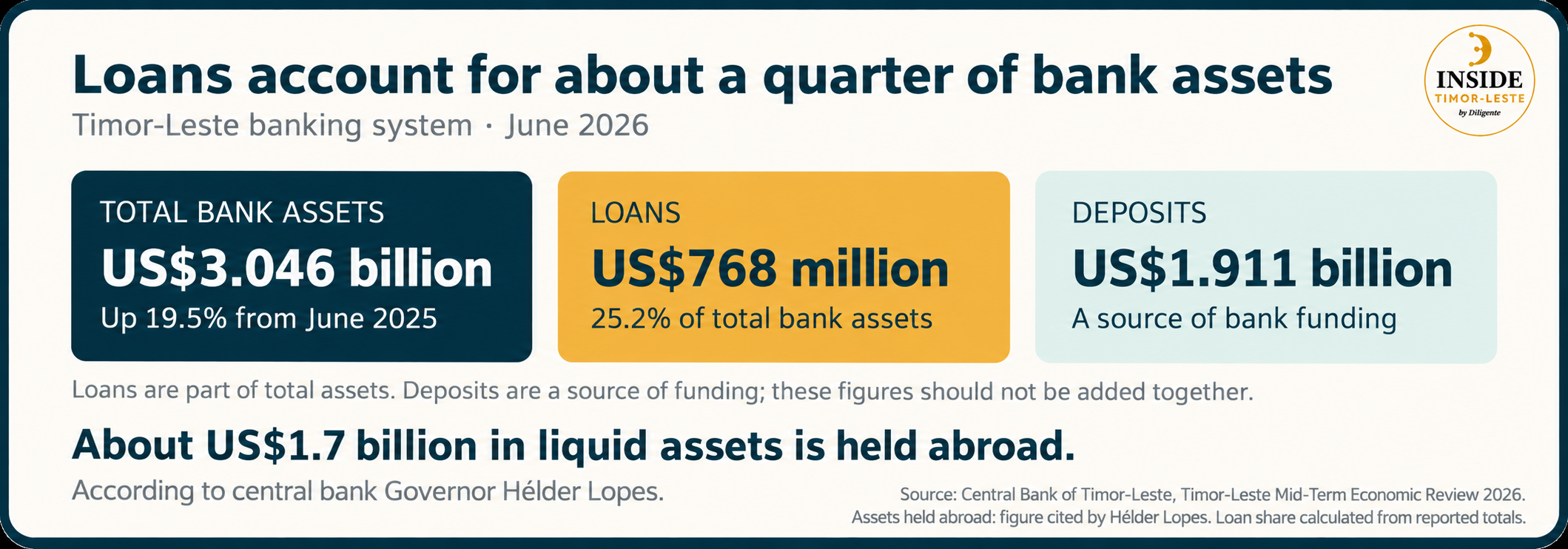
BCTL Governor Hélder Lopes said about $1.7 billion in banks’ liquid assets — cash and investments that can be readily accessed — is held abroad.
“We’re not satisfied with that. We want that money circulating in our economy,” he said.
Lopes also acknowledged that little financing goes toward productive activity.
“There is a lot of credit for consumption, while credit for the real sector, for productive economic activity, remains minimal,” he said.
For the BCTL, the challenge is to direct a larger share of available resources toward financing the domestic economy. But the gap between banks’ liquidity and lending for production has no single explanation.
Manufacturing and agriculture receive 2.4% of lending
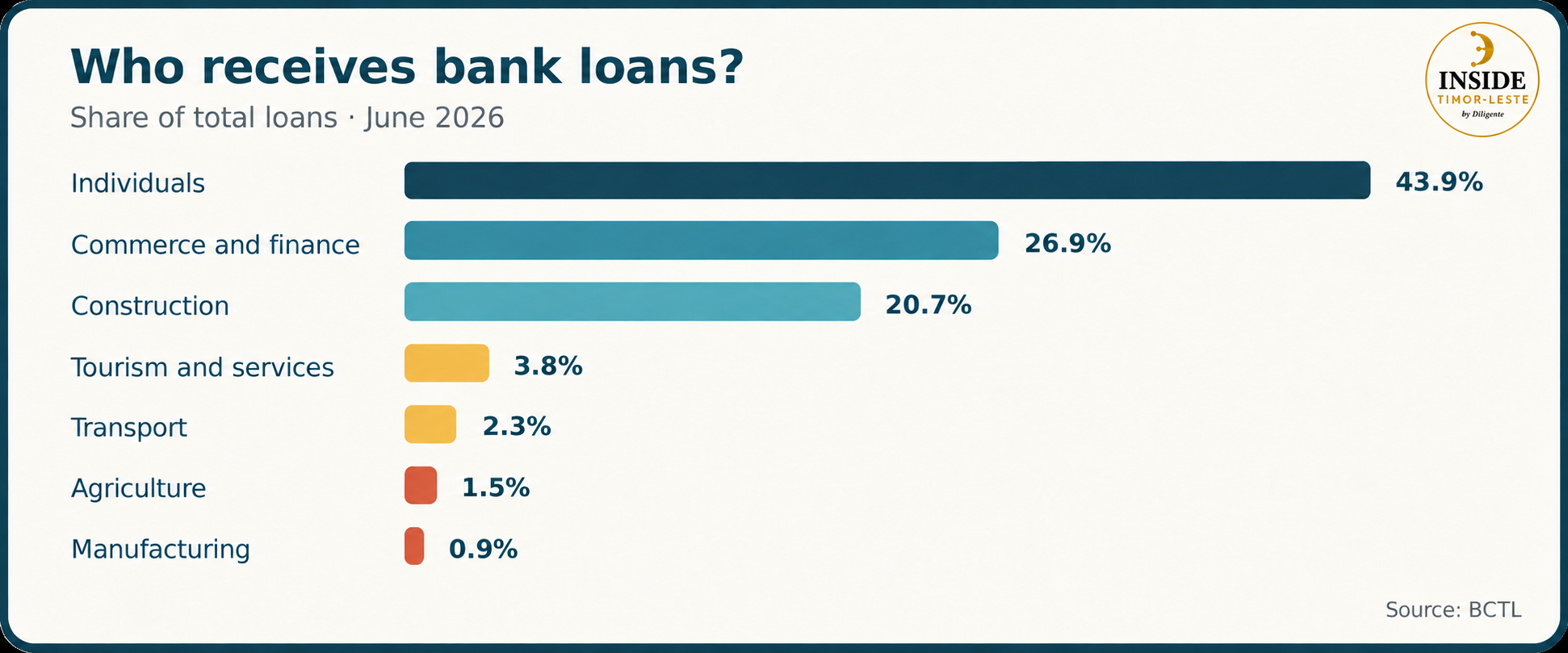
Credit is not only limited; it is also concentrated in a few sectors. In June 2026, individuals, trade and finance, and construction together accounted for 91.5% of loans.
Loans to individuals made up 43.9% of lending, or $336.8 million. Trade and finance accounted for 26.9%, or $206.4 million, while construction received 20.7%, or $159.1 million.
By contrast, manufacturing received just 0.9%, or $6.7 million, and agriculture accounted for 1.5%. Transportation received 2.3%, or $17.9 million, while tourism and services accounted for 3.8%, or $29.1 million.
The World Bank has highlighted the limited scale of private-sector financing. In 2024, it reported that private-sector credit amounted to 28.9% of gross domestic product (GDP), one of the lowest levels in the world. It also identified difficulties accessing financing and limited use of digital financial services.
The International Monetary Fund (IMF) reported a different figure for the same year: 33% of GDP, up from 27% in 2023. Despite that increase, credit remained well below the median for countries in the Association of Southeast Asian Nations (ASEAN). Both figures point to how little credit reaches the private sector.
Growth in lending was also uneven across institutions. According to the IMF, the National Commercial Bank of Timor-Leste (BNCTL) held 75% of the banking system’s loans and accounted for most of the growth, while lending by private banks grew only modestly.
Interest rates decline slowly
Credit is also expensive. The average lending rate was 10.3% in June 2026, according to the BCTL.
Historical IMF data show a gradual decline: The rate stood at 11% at the end of 2022, 10.7% in 2023 and 10.5% in 2024. Measured against the central bank’s June 2026 figure, that is a drop of just 0.7 percentage points over roughly three and a half years.
At the end of 2024, the most recent figure available, nonperforming loans represented 2.2% of bank credit, a level the IMF considered low.
For Tilman, interest rates are only part of the problem. Land and vehicles are among the assets used as collateral, but property valuations can complicate matters, she said. A gap between an owner’s valuation and the bank’s appraisal may mean the company has to pledge more assets, increasing its exposure to risk.
“If I borrow $25,000 and have to put up my land as collateral, I could lose everything if I have trouble repaying the loan,” she said.
Tilman wants clearer standards for land appraisals, greater flexibility on collateral and grace periods for investments that take time to generate revenue.
She also believes banks should adjust lending terms when extraordinary circumstances temporarily disrupt a business. Public works such as road widening can cut the number of customers without making the business itself unviable.
Tilman said banks should monitor and support the projects they finance, rather than simply seizing vehicles, equipment or property when borrowers run into trouble. Late government payments to private businesses, she added, can make it harder for them to keep up with their loans.
“The bank cannot leave the customer on their own. It should also follow up to make sure the business is in a position to repay the loan,” she said.
Property titles and financial records
The central bank sees obstacles on both sides: in lending and in demand for credit.
“Demand for credit from businesses is still minimal,” Lopes said.
Collateral is one constraint. Without documents clearly establishing ownership of land or a building, a bank may be unable to accept the property as security for a loan.
In 2025, the World Bank warned that uncertainty over land ownership limits private investment. It called for a more efficient system for issuing property titles to encourage investment and create jobs.
Banks also cite a lack of information about businesses. Ana Andrade, deputy director-general of BNU Timor, which takes its name from Banco Nacional Ultramarino, said many companies lack organized accounting records and standardized financial information.
“Businesses in Timor-Leste are not currently required to maintain organized accounting records,” she said.
To assess a loan application, BNU examines a company’s sales, assets, income and expenses, existing loans and its projected cash flow.
Andrade said the bank already lends to companies that voluntarily keep organized accounting records, although the law does not require it. If more companies did so, she said, assessing risk would be easier.
Beyond financial records and collateral, companies must provide detailed information about the proposed investment.
For an agricultural project, the bank examines the product, the location and size of the cultivated area, costs, expected output, the number of production cycles and projected revenue. For coffee production, it also considers the selling price and potential buyers.
“We need to understand the entire project,” Andrade said.
Insufficient collateral, a lack of transparency, incomplete financial information or problems with the business model can prevent approval, she said. The bank also checks that the money is used for its stated purpose.
Interest rates are negotiated case by case, based on the project, the business plan and the company’s ability to repay principal and interest. BNU also offers a credit line with a fixed 5% rate for investments in sustainability and the green economy, including solar energy, recycling and other activities intended to reduce environmental impact.
Andrade said the bank generally does not offer very long-term loans, but she did not specify its loan terms.
She did not have figures on hand for how many loan applications BNU received, approved or rejected in 2025. But she said the bank receives “a normal number of applications for the Timorese market.”
Andrade also rejected claims that BNU favors international companies over Timorese businesses. She said the bank’s loans in Timor-Leste go to companies operating in the country.
BNU is supervised by the BCTL and, as part of a European banking group, follows the group’s credit-assessment criteria and applicable rules, she said. Its caution also reflects its responsibility to depositors.
“We are intermediaries. We hold deposits and lend money,” she said.
Andrade identified agriculture, tourism, manufacturing and construction as sectors with potential for lending. She highlighted coffee and vanilla production, as well as tourism projects that combine economic activity with environmental protection and biodiversity conservation, including initiatives linked to the blue economy.
The blue economy refers to the sustainable use of ocean resources to support economic activity and livelihoods while protecting marine ecosystems.
In her view, more formalized businesses, transparent financial information and economically viable projects would improve access to credit and help increase domestic production.
Small businesses need capital but avoid debt
Low demand for credit does not necessarily mean businesses have no need for financing. Unpredictable revenue and fear of being unable to repay a loan keep some small-business owners from applying.
Grecia Maria Batista Xavier, 23, who owns a small burger stand, avoids borrowing because she does not know how much she will sell each day.
“There are good days and bad days. Today we might have a lot of customers and tomorrow only a few. We don’t sell essentials,” she said.
Xavier worries about paying 10% or 15% interest, and credit lines with 5% rates are not always available to businesses like hers. She prefers to keep an emergency fund and grow gradually.
She started the business in 2023 with a street cart, then moved into a small wooden stall. She moved to her current spot after authorities banned roadside vending. She employs three people and pays $350 a month in rent.
She knows she needs capital to grow but worries that borrowing under current conditions could put the business at risk.
Other companies are preparing larger investments. César Trinito Gaio, founder and owner of Dilicious, a restaurant and hospitality company, plans to seek financing in 2027 for a $200,000-to-$250,000 project at Praia do Dólar.
The company has no bank debt and is comparing the terms offered by the BNCTL and Banco do Nosso Futuro (BNF). Gaio said he had heard of rates of 6.5% to 7%, but he had not submitted an application and did not know what documents or collateral would be required.
“If the loan process were simpler, it would also be easier to invest,” he said.
Bureaucracy and dependence on public contracts
La’o Hamutuk points to another obstacle: red tape.
Élia da Costa Araújo, a researcher and spokesperson for the organization, said excessive and complex procedures make it harder for micro, small and medium-sized businesses to obtain financing.
The organization also cites a shortage of skilled workers and the fragility of a private sector heavily dependent on government spending and contracts. That dependence can hurt borrowers when the government falls behind on payments.
La’o Hamutuk argues that oil revenue should fund the development of domestic skills and support activities that add value within Timor-Leste. Public assistance, it says, should follow transparent criteria and produce measurable results without creating permanent dependence on the state.
Limited production and reliance on imports
The concentration of lending among individuals, trade and finance, and construction affects more than businesses seeking loans. In a country with limited productive capacity, it also makes it harder to develop sectors that could replace imports and increase exports.
In the first half of 2026, Timor-Leste imported $565.6 million in goods. Domestic non-oil exports totaled just $15.5 million. Including re-exports, total non-oil exports reached $19.7 million.
For every dollar in non-oil exports, including re-exports, the country imported nearly $29 in goods.
Lopes pointed to how small exports are and how heavily they rely on coffee.
“The volume of exports is very small compared with imports. Our exports are also concentrated: We essentially have coffee, while other products account for very little,” he said.
The BCTL forecasts real non-oil GDP growth of 5% in 2026, following estimated growth of 4.5% in 2025. It acknowledges, however, that domestic productive capacity remains limited, so imports cover part of the rise in demand.
For now, a large share of banks’ liquid assets remains abroad, while manufacturing and agriculture receive only a sliver of lending. Businesses describe obstacles involving interest rates, collateral, bureaucracy and repayment terms; banks continue to cite inadequate accounting records and financial information as barriers to lending.
Lopes called for closer coordination among the central bank, commercial banks and the government to finance productive activity. He said the priority should be supplying the domestic market before expanding sales abroad.
“First, we need to replace imports by producing locally what we now buy abroad. Then, when we produce more than we can consume at home, we can promote exports,” he said.