
In occupied Timor-Leste, songs kept the spirit of resistance alive
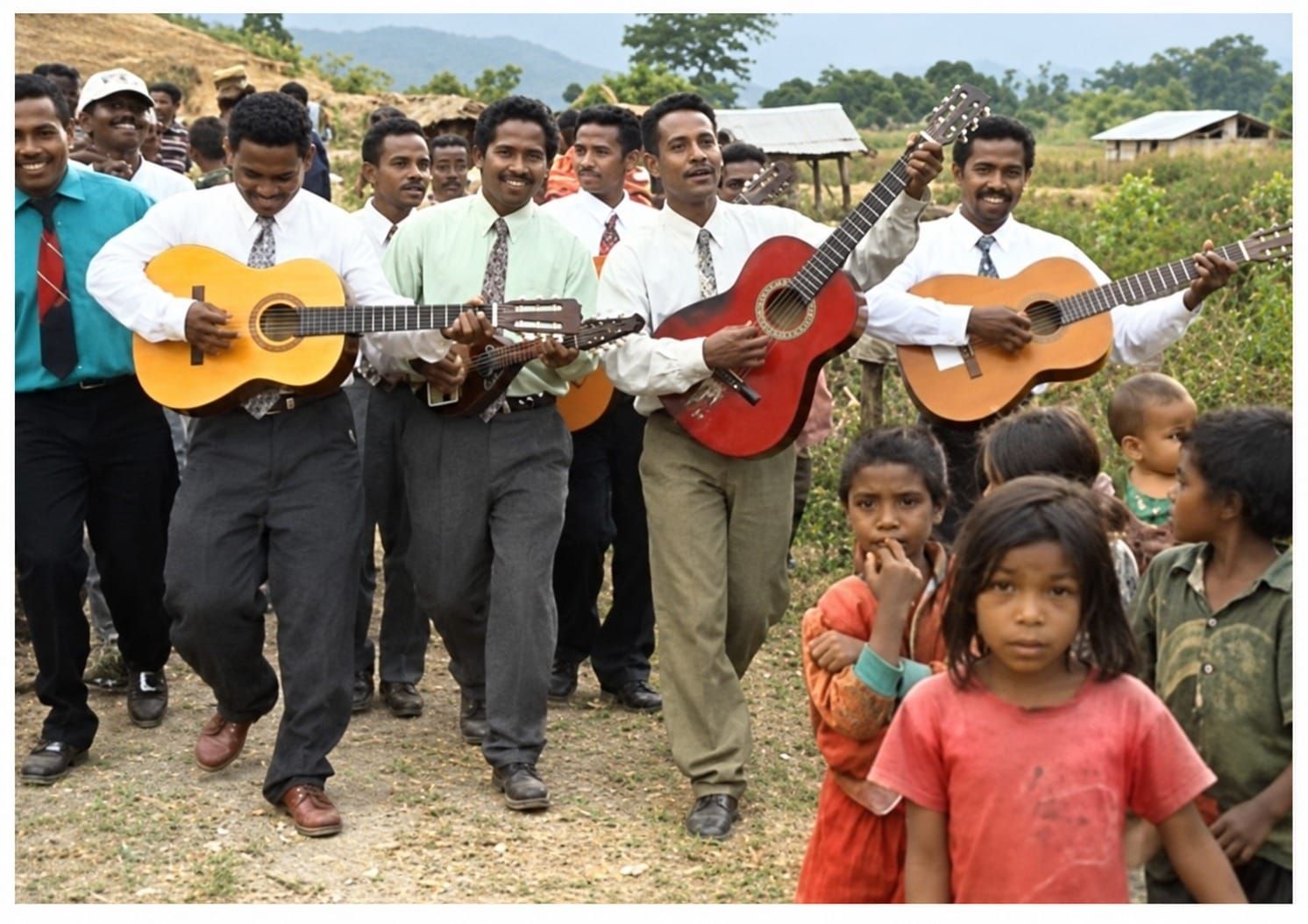
Under Indonesian military surveillance, Timorese musicians captured hunger, loss and the longing for freedom in songs that often concealed political messages.
By Lourdes do Rêgo
Originally published by Diligente on Sept. 21, 2026.
DILI, Timor-Leste — When Indonesian military operations destroyed the resistance’s support bases in the late 1970s, many civilians sheltering there went hungry. Some fell ill or died, and many of the dead were left where they fell.
The bases were areas in the mountainous interior where resistance fighters and civilians lived together. They served both as centers of resistance and as places of refuge after Indonesia invaded in December 1975.
Timor-Leste, also known as East Timor, is a former Portuguese colony in Southeast Asia. It declared independence on Nov. 28, 1975. Fretilin, a Timorese independence movement, declared independence and led the early resistance to the Indonesian invasion, which began nine days later.
Years later, musician Chico Ramelau turned his memories of life in the support bases into “Tansa La Dame,” a song he wrote with Quito Sousa. Born in 1968 in Aileu municipality, Ramelau experienced life in the support bases as a child between 1976 and 1979.
“This song is about what [Ramelau] witnessed in the support bases during the intensive military operations, when Indonesia destroyed them,” said Apolinário Ximenes, a researcher who has studied the song. “The song reflects that situation.”
“Tansa La Dame” is one of many songs in which Timorese musicians chronicled the Indonesian occupation, which lasted from 1975 to 1999. Some spoke openly of hunger, death and separation. Others concealed their messages in lyrics about food or everyday life.
The chorus of “Tansa La Dame” speaks of tears, suffering, hunger, peace and hope:
Ho matan been tanis harohan
Ba Na’i Maromak husu nia tulun
La’o lemorai kulit taka ruin
Isin laiha rate mós laiha
Bainhira dame ita sei haksolok
Moris iha dame nia laran
Kaer liman ba dame malu ba
Laiha moris se la hadomi.
With tears, we weep and pray
To the Lord God, asking for his help
Wandering, skin stretched over bone
No flesh left, and no grave either
When peace comes, we will rejoice
Living in peace
Let us join hands; let us be at peace with one another
There is no life without love.
Ramelau and Sousa recorded the song between 1993 and 1995 at Atika Record. Sousa is a Timorese singer-songwriter known for performing classic and resistance songs in Tetum, Timor-Leste’s most widely spoken language.
The song became popular in 1996. Indonesian military authorities came to see it as an expression of opposition to the occupation and later intimidated Ramelau and Sousa, according to Ximenes.
Ximenes examines several such songs in his 2023 book, “Musika Popular Rezisténsia iha Periode Okupasaun” (“Popular Resistance Music During the Occupation”). He spent about a year and a half researching the book, interviewing witnesses, people involved in the resistance, listeners and more than 10 musicians.
The book was published by Centro Nacional Chega!, a state institute established in 2016 to preserve the memory of the occupation and promote the implementation of recommendations made by the country’s truth commissions. Those commissions investigated human rights abuses during the conflict and the violence surrounding the 1999 independence referendum. Ximenes has worked at the institute as a researcher since 2017.
Songs from the mountains
Timorese resistance music predates the Indonesian invasion. Some songs emerged in 1974 and 1975, during the final years of Portuguese colonial rule, said José Agostinho Sequeira, a former guerrilla known by his wartime alias, Somotxo.
“At that time, songs emerged about the relationship between the colonized and their colonizers, as well as songs about the revolution,” said Somotxo, who later became the first director of the Timorese Resistance Archive and Museum.
Two of the best-known songs from that period, “Foho Ramelau” and “Kadalak Sulimutu,” featured lyrics by poet Francisco Borja da Costa and music by Abílio Araújo. “Foho Ramelau” is named after Mount Ramelau, the country’s highest peak. Araújo has described “Kadalak Sulimutu” as a call for unity, and the resistance used it to keep its fighting spirit alive. Borja da Costa was killed on the first day of the Indonesian invasion.
In the support bases, music helped people share their experiences, build solidarity and make sense of what was happening around them. That role was especially significant in a territory where much of the population had had little access to schooling under Portuguese rule.
“Music is very effective. For example, someone who never went to school can listen to music and understand what people lived through. It also encourages people to question the injustices they face,” Ximenes said.
The songs also carried a call to sacrifice.
“Resistance songs expressed the feelings of those in the resistance and called on guerrillas to show courage and make sacrifices,” Somotxo said. “They also called on people in the towns to learn about those sacrifices and think about what they could contribute.”
Saying it without saying it
After the support bases fell, guerrillas remained in the mountains. Clandestine networks of people secretly working for the resistance in towns and villages became central to the struggle. According to Ximenes, popular music emerged among young people in those networks and among survivors of the support bases.
Musicians had to rely on studios operating under the occupation. Recording and distribution were subject to military surveillance and censorship, Ximenes said, so songs rarely called openly for resistance.
“Artists did not always speak directly about what was happening. They used music to convey messages indirectly,” he said. “Songs could be about everyday life or other subjects, but they took on a different meaning when heard in the context of the occupation.”
Copied onto cassettes, the songs circulated from one municipality to another and were played at community gatherings.
“Tahu Tempe” illustrates how musicians concealed political messages in seemingly ordinary lyrics. Pedro Madeira, a musician from Ermera known as Apeu Tahu Tempe, began writing the song in November 1996, when he was 21.
He wanted to celebrate that year’s Nobel Peace Prize, awarded to two prominent figures in Timor-Leste’s struggle: Bishop Carlos Filipe Ximenes Belo and exiled activist José Ramos-Horta. Indonesia had condemned the decision to award the prize to Ramos-Horta.
Ramos-Horta is now Timor-Leste’s president. Belo later settled in Portugal. In 2022, the Vatican confirmed that it had imposed sanctions on him over allegations that he had sexually abused boys in Timor-Leste in the 1990s.
Madeira realized that a song interpreted as opposing the occupation could put him in danger. He rewrote parts of it and changed its title from “Nobel da Paz” (Nobel Peace Prize) to “Tahu Tempe,” a reference to tofu and tempeh, two soy-based foods associated with Indonesia. On the surface, a song about a peace prize had become a song about food.
Even with those changes, he was detained. Indonesian military authorities interrogated Madeira at the army’s district military command, known by its Indonesian acronym, Kodim.
The interrogation focused on the line about food coming from “across the sea”:
Lalika temi tan paun ho keju
Tahu tempe mai hosi tasi sorin
Ida nee mak malae ho bapa nia ai-han
Dader ami ba sei toos
Kee ai-farina fehuk batar no talas
Ida nee mak ami Timor-oan nia ai-han
No need to talk of bread and cheese anymore
Tofu and tempeh come from across the sea
That is what the malae and the bapa eat
In the morning, we will go to the fields
For cassava, potatoes, corn and taro
That is what we Timorese eat.
Timorese use “malae” for foreigners from Europe, the Americas and Australia, and “bapa” for Indonesians. The lyrics contrast foods associated with outsiders — bread and cheese, tofu and tempeh — with crops grown and eaten by Timorese people. What sounds like a description of meals also emphasizes a distinct Timorese identity.
Madeira was eventually released.
“These songs are not directly or specifically against Indonesia, but they reflect an effort to preserve the spirit of resistance, which we still carry within us,” Ximenes said.
Songs for the vote
That spirit endured until 1999, when Timorese voted in a United Nations-organized ballot on their political future, Ximenes argues. Music helped sustain it alongside other forms of struggle, he said.
The vote, officially known as the Popular Consultation, took place on Aug. 30. Voters were asked whether they accepted a proposal for special autonomy within Indonesia. Rejecting it meant choosing a path toward independence.
For musicians, the risks had been real for years. Singer Leo Moniz told Diligente in a 2025 profile that in the early 1990s, he and others sang only at informal gatherings because circulating the songs was dangerous.
One song written to encourage people to vote was “Oras To’o Ona” (“The Time Has Come”), by the Lahane Group, whose members included Moniz, Anito Matos and Zeca Smith. It was recorded under threat from pro-Indonesian militias — armed groups that opposed independence.
“We recorded it secretly, in a hurry, so the militias wouldn’t catch us,” Matos, who had been performing since 1979, told Diligente in a 2023 profile. After the song was released, he said, his name was put on a blacklist.
Moniz said staff members from the U.N. mission organizing the vote had asked the musicians for a song encouraging people to participate. Some Timorese informed on the musicians to the Indonesian military, he recalled.
“After each performance, we had to hide,” he said.
Despite the pressure and violence before the vote, 78.5% of voters rejected autonomy within Indonesia. In the weeks that followed, pro-Indonesian militias, backed by elements of the Indonesian military, killed hundreds of people and destroyed much of the territory’s infrastructure. After nearly three years of U.N. transitional administration, the country formally became independent on May 20, 2002.
“I think music also contributed to our struggle for independence,” Ximenes said.
An unfinished history
The songs preserved experiences that might otherwise have been lost. Yet much of the history behind them remains undocumented.
Somotxo acknowledged that he does not have a complete picture of who created and circulated them. Writing a fuller history of Timor-Leste’s resistance music will require identifying the composers and performers and documenting the circumstances in which each song emerged, he said.
For Ximenes, historical research must go beyond gathering information. It also requires understanding how works of art relate to a society’s experiences.
“Artists had little power at a very difficult time, but they used their talents to make the injustices of the occupation known,” he said.
Protest songs today
The tradition did not end with independence. Timorese artists still sing about injustice, though individual voices do not always come together in an organized movement, Ximenes said.
He pointed to Klamar, a Timorese band known for songs that criticize the government and take on subjects such as diversity and evictions. The band’s vocalist, Otopsy, told Diligente in 2024 that music should push leaders to make decisions with citizens’ well-being in mind.
Ximenes said songs alone cannot bring about deeper social change.
“Artists, students and all citizens have a responsibility to inspire people to stand up against injustice in our country,” he said.
“You don’t have to do something grand to contribute to change. We can also contribute through art.”