
Timor-Leste Counts Poverty. Families Count the Cost.
As competing poverty figures fuel a national debate, three households reveal the daily calculations behind food, school expenses and debt — and how little room remains when something goes wrong.
By Lourdes do Rêgo · Adapted from Diligente
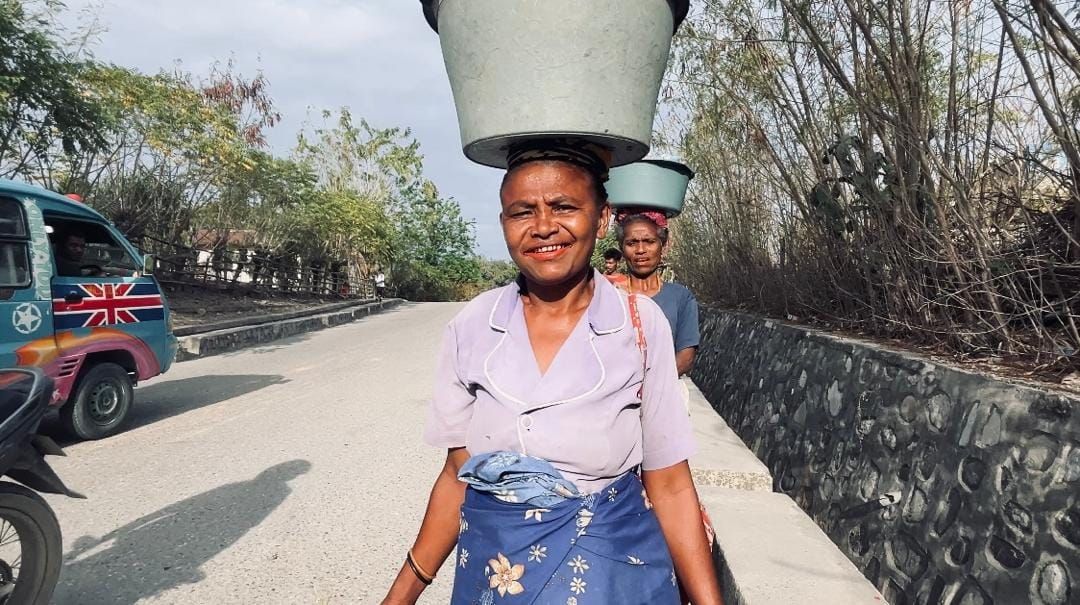
DILI, Timor-Leste — At five in the morning in Bidau Santa Ana, Jacinta Kaet prepares two things: breakfast for the children and hot water for the coffee she will sell.
Her workday begins. What she sells will help pay for the household she has supported since her husband died in 2024: her two daughters, ages 6 and 10, and two relatives, ages 18 and 19, who live with her and attend high school.
Jacinta, 45, works six days a week. She receives no pension and no regular support from the state or the two young relatives' families.
On a normal day, her sales total about $20. On a good day, sales reach $30. But that money is not all hers to spend. She must buy coffee, sugar and noodles to keep selling the next day.
She does not keep complete records of her sales and expenses and cannot say how much profit she makes in a month.
The family eats three meals a day. Rice is bought regularly. Chicken, sausages and eggs depend on whether there is enough money.
"We normally spend $5 a day on food, or a little more if the children want eggs," she told Diligente.
This month, a different calculation dominated public debate: how many people in Timor-Leste live in poverty?
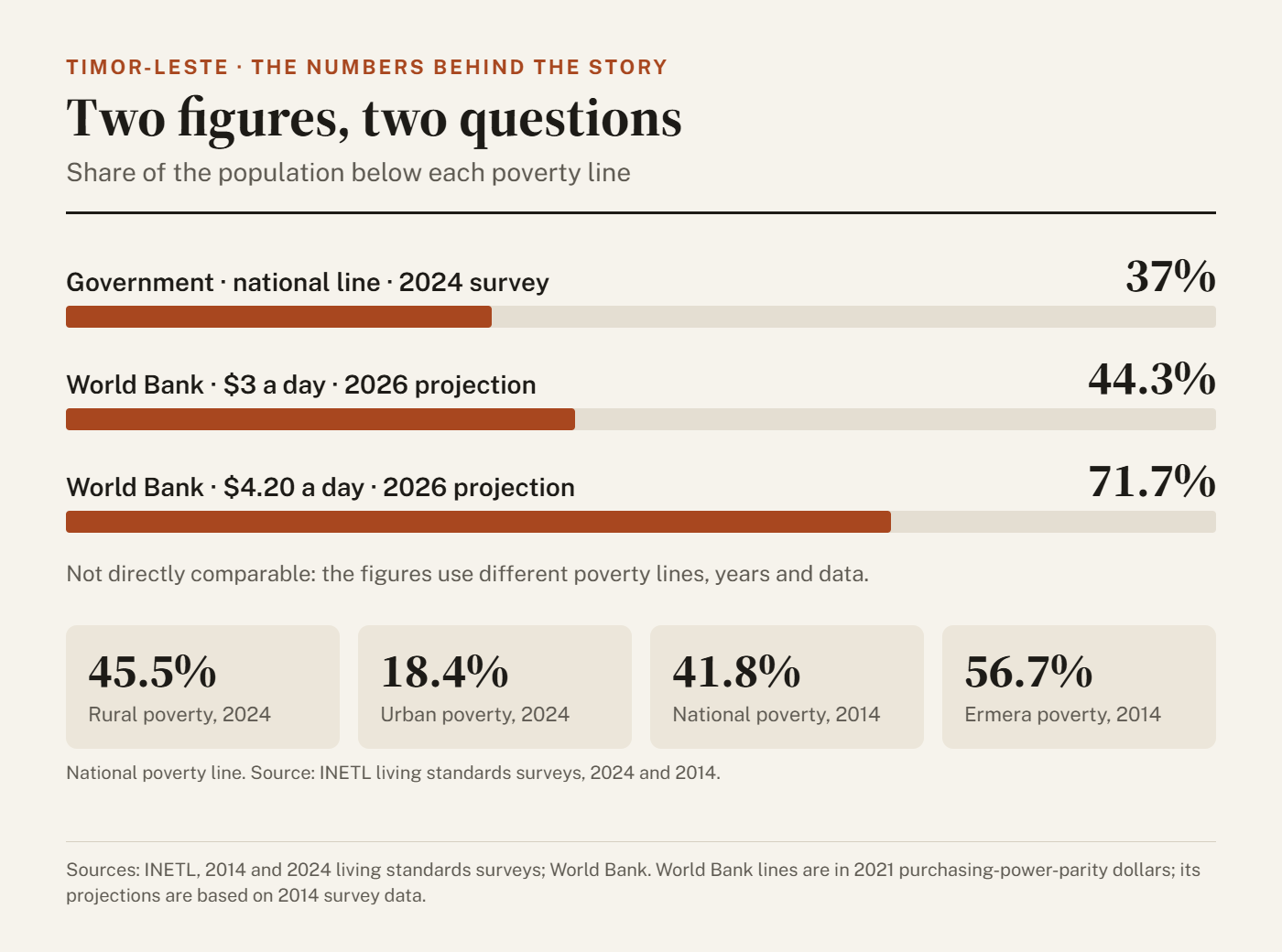
The government announced that 37 percent of the population lived below the national poverty line in 2024, down from 41.8 percent in 2014. Earlier, the World Bank had projected that 71.7 percent would fall below a higher international threshold in 2026.
The percentages competed for attention. But they do not measure the same thing.
They use different poverty lines, refer to different years and draw on different survey evidence. Neither figure, on its own, explains how Jacinta pays for tomorrow's food — or what happens when an expense exceeds what she has put aside.
At the time of Diligente's reporting, the monetary value of the national poverty line at 2024 prices had not yet been released. The National Institute of Statistics of Timor-Leste, INETL, said the full report would be published in October.
The most recent publicly available national line, calculated for 2014, averaged $46.37 per person per month for basic needs, including food, housing and other expenses.
The accounts of Jacinta's household and two others cannot establish a new poverty threshold. They reveal the decisions behind a monthly budget: what gets paid, what gets cut and where the money comes from when it runs out.
Today's sales, tomorrow's expenses
Jacinta buys vegetables every day and eggs or sausages when she can afford them. The rice she buys lasts about two weeks, or less when visitors come.
On school days, she gives each of the two teenagers $1 and her 10-year-old daughter, who walks to school, 50 cents. Those allowances add up to $2.50 a day — about $50 in a month with 20 school days.
Electricity costs roughly $4 a week. Her electric stove cooks the family's food and heats the water for the coffee she sells. The household and the business run on the same electricity bill.
She pays no water bill and lives in a house on land belonging to an uncle. When the health center does not have the medicines she needs, she buys them at a pharmacy.
On days when she can afford to, Jacinta puts aside $2 to $2.50. When sales fall short, she draws on that reserve.
A salary arrives. The debt remains.
Yane Maia knows what Jacinta cannot: how much she will receive at the end of the month.
The 32-year-old civil servant earns about $500 a month and lives in Dili in a household of five. Rent takes $200. Food takes roughly another $200. Before the other bills are paid, those two expenses alone account for 80 percent of her salary.
The children's father contributes about $150 to $200 a month toward household expenses. Yane occasionally earns extra money from crochet work and tutoring students.
The family buys rice, vegetables, eggs, cooking oil, fruit, tofu, tempeh and, when possible, meat. She has stopped buying some seasonings to save money for essentials.
"We rarely have breakfast. It saves money, and besides, the three adults in our household are no longer in the habit of eating breakfast," she said. "We have two main meals a day, while the children eat five times, including two main meals."
There are also school expenses, transportation, phone service, motorcycle maintenance, water and electricity. The public water supply is limited or unreliable. The family collects drinking water elsewhere or buys it from kiosks.
Then there is the debt.
Yane owes more than $500 to an informal cooperative charging 5 percent interest a month. For now, she pays only the interest: at least $25 each month.
If the balance and rate remain unchanged, a year of payments will cost at least $300 without reducing what she owes.
She has already repaid a separate $600 loan taken out when her father fell ill.
To make the budget work, Yane has stopped paying for one sister's transportation, cut back on books and suspended financial support for her mother and another sister.
Resuming those expenses would require an additional $110 to $140 a month, she estimates: $20 for transportation, $40 to $70 for books and at least $50 for family support.
"In this household, I'm the one who works. Everyone else studies," she said. "When someone gets sick, expenses go up because we have to buy medicine and food to help them recover. If the situation is more serious, we borrow money, and it's hard to pay back."
Even with a regular payday, Yane does not consider her family completely financially secure.
The gap between two poverty figures
The government's 37 percent figure comes from the 2024 living standards survey, which covered about 7,500 households and used the national poverty line.
The initial results show a substantial divide: poverty affected 45.5 percent of people in rural areas and 18.4 percent in urban areas.
The World Bank's 71.7 percent figure is a projection for 2026 using an international poverty line of $4.20 per person per day, expressed in 2021 purchasing-power-parity dollars. This is the international benchmark for lower-middle-income countries, the group to which Timor-Leste belongs.
Purchasing-power-parity dollars account for price differences between countries. The $4.20 threshold is therefore not a cash amount directly comparable with the U.S.-dollar wages and expenses in these household budgets.
The bank also projected that 44.3 percent of the population would fall below the $3 international line in 2026. It considers that threshold closer to Timor-Leste's circumstances, despite the country's lower-middle-income classification. In 2021 purchasing-power-parity terms, the most recent publicly available national poverty line was equivalent to $2.93 per person per day.
The figures also rest on different evidence.
The international projections do not come from household interviews conducted in 2026. They were calculated using the 2014 living standards survey, the latest publicly available survey used for those estimates, and assumptions about how economic growth translates into poverty reduction.
The World Bank says it will update its international estimates after the official 2024 survey data are published.
Earlier this month, Prime Minister Xanana Gusmão disputed the World Bank's figure. Days later, the government presented the initial findings of the 2024 survey. David Freedman, the bank's representative in Dili, clarified that the 71.7 percent estimate was based on the 2014 data.
The two rates do not establish that one institution found almost twice as much poverty as the other.
The national line measures the cost of basic needs under local conditions. International lines are designed for cross-country comparisons. The World Bank cautions against directly comparing international poverty rates with national ones.
In 2014, the national line also varied geographically to reflect local prices and consumption patterns and was higher in Dili than in Ermera.
Less borrowing. More dependence.
In Riheu, Ermera, Domingos de Jesus knows what it means to borrow for food.
The 68-year-old farmer and his wife grow some of what they eat and sell produce when buyers are available.
"We can sell taro, cassava and other produce from our garden," he said. "But people do not buy every day. Sometimes we make only $15 in a month."
In 2014, the latest year for which municipal poverty figures were publicly available at the time of Diligente's reporting, 56.7 percent of Ermera's residents lived below the national poverty line, compared with 41.8 percent nationwide. The municipality's rate for 2024 had not yet been released.
The couple spends about $50 a month on food, including rice, cooking oil and meat, in addition to what they grow for their own consumption. Goods unavailable in Riheu require a trip to Gleno, the municipal capital.
Water is free. Electricity and medicines are not.
A visit to a matan-dook, a traditional medicine practitioner, can cost $50 — a month's worth of the food Domingos says the couple buys.
Their four sons no longer live at home. Three work in Dili and help when they can. The fourth works in South Korea and, according to Domingos, can send up to $500 in some months.
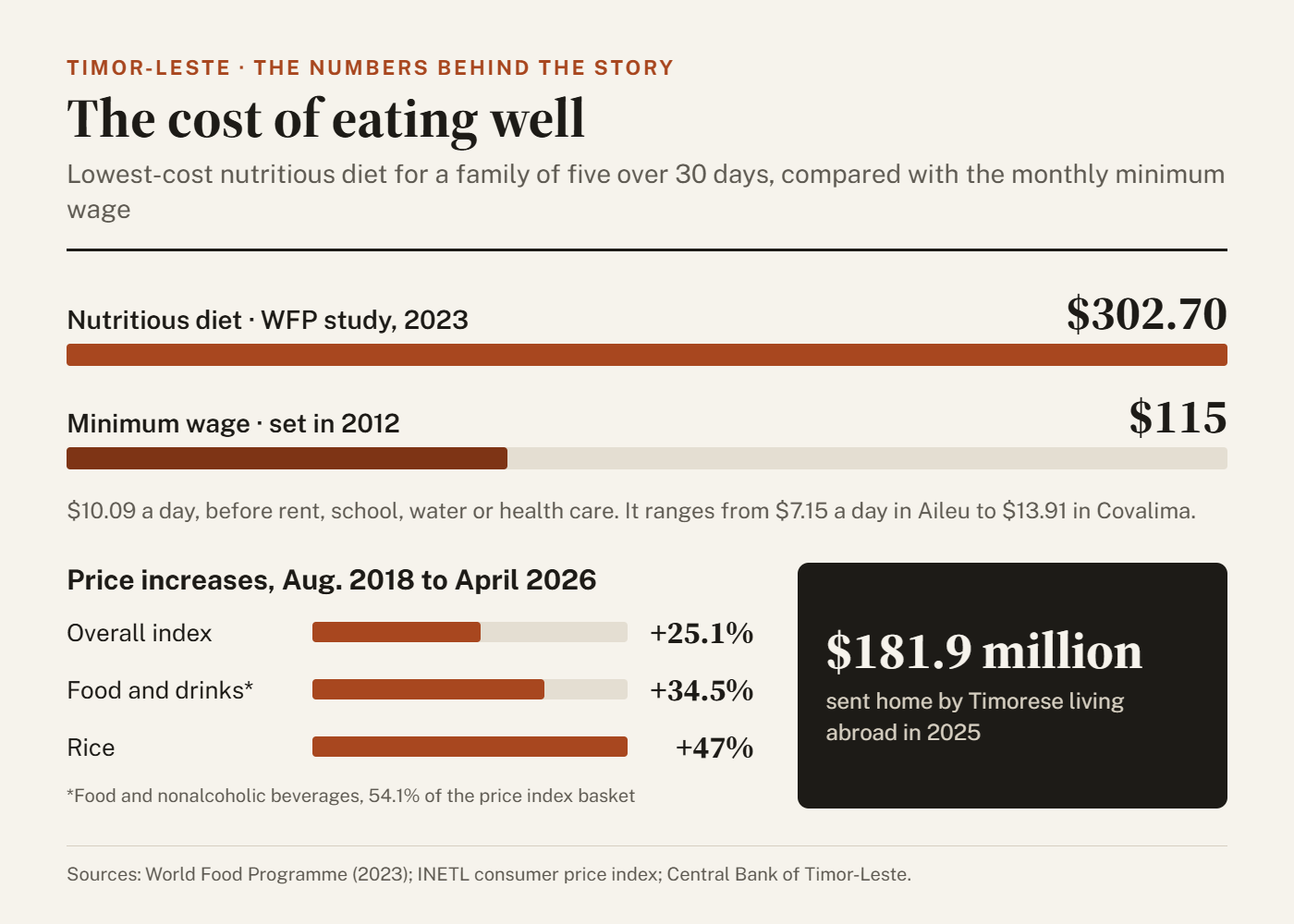
Remittances — money sent home by Timorese living abroad — totaled $181.9 million in 2025, according to the central bank.
"Before, when my sons were not yet working, I had to borrow money to buy cooking oil and vegetables," Domingos said. "Now that they work and give me money, we no longer need to borrow as we did before."
Their support has changed the couple's circumstances. The improvement depends on money Domingos and his wife do not earn or control themselves.
Enough calories are not the same as adequate nutrition
Jacinta buys food as money comes in. Yane has cut some purchases, and the adults in her household rarely eat breakfast. Domingos buys staples but also eats what he grows.
Their spending shows what they buy. A separate calculation asks what it would cost to meet their nutritional needs.
A 2023 World Food Programme study estimated that the lowest-cost diet meeting the nutritional requirements of a family of five averaged $10.09 a day in Timor-Leste.
Over 30 days, that is $302.70 — before rent, school, water or health care.
The estimated cost was 78 percent higher than in 2019. It ranged from $7.15 a day in Aileu to $13.91 in Covalima. The national monthly average was more than twice the $115 minimum wage established in 2012.
The study calculated the cost of meeting energy and nutrient requirements. The food component of the 2014 national poverty line used a basket providing 2,100 calories per person per day. Sufficient calories and a nutritionally adequate diet are different measures.
Prices have also risen since the most recent publicly available national poverty line was calculated.
In INETL's current consumer price index series, which uses August 2018 as its base, the overall index rose 25.1 percent through April 2026. Food and nonalcoholic beverage prices rose 34.5 percent over the same period. Rice prices rose 47 percent.
Food and nonalcoholic beverages account for 54.1 percent of the index's reference basket.
In April 2026, overall prices were roughly unchanged from a year earlier. That stability did not undo the increases since August 2018.
When the budget no longer balances
The three households are not a representative sample, and the figures they reported cannot show whether each is poor.
Jacinta's sales are not her profit. Domingos' food purchases exclude what he grows and eats. Yane's salary is only part of her household's income. These figures do not provide a complete measure of household consumption.
Their accounts show how they cover their expenses.
Jacinta puts aside a few dollars to cover days when she sells less. Yane has stopped helping her mother and sister while continuing to pay interest on her debt. Domingos borrows less often for food because his sons help.
These decisions cannot be read from a poverty rate alone. They show where each household finds room to absorb an expense — and how limited that room can be.
For Jacinta, it is the reserve built a few dollars at a time. For Domingos, it is help from sons living elsewhere. For Yane, there is little room left: another serious illness could mean borrowing again.
For now, she continues paying interest without reducing the principal.